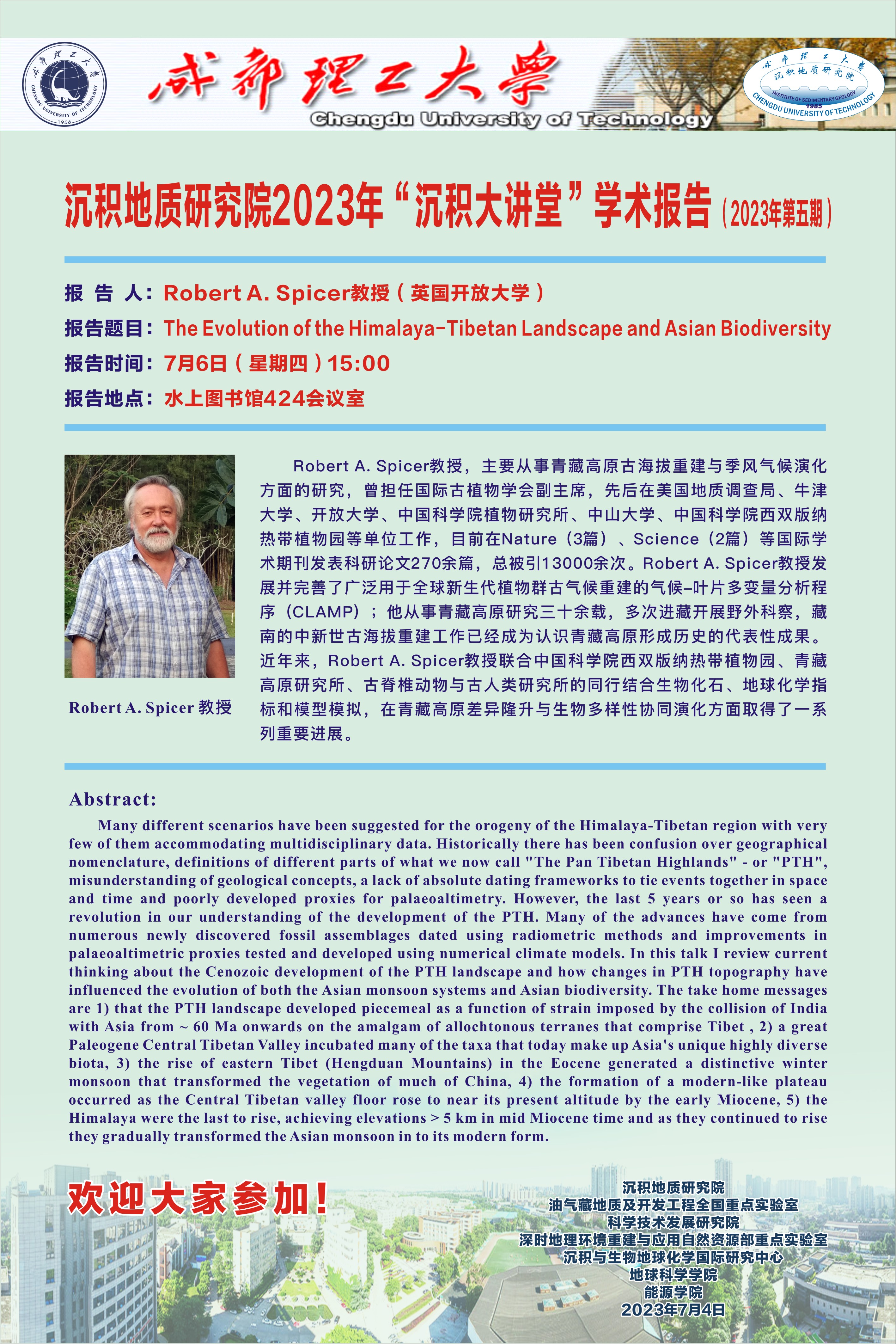
报告人:Robert A. Spicer教授(英国开放大学)
报告题目:The Evolution of the Himalaya-Tibetan Landscape and Asian Biodiversity
报告时间:7月6日(星期四)15:00
报告地点:水上图书馆424会议室
报告人简介:Robert A. Spicer教授,主要从事青藏高原古海拔重建与季风气候演化方面的研究,曾担任国际古植物学会副主席,先后在美国地质调查局、牛津大学、开放大学、中国科学院植物研究所、中山大学、中国科学院西双版纳热带植物园等单位工作,目前在Nature(3篇)、Science(2篇)等国际学术期刊发表科研论文270余篇,总被引13000余次。Robert A. Spicer教授发展并完善了广泛用于全球新生代植物群古气候重建的气候-叶片多变量分析程序(CLAMP);他从事青藏高原研究三十余载,多次进藏开展野外科察,藏南的中新世古海拔重建工作已经成为认识青藏高原形成历史的代表性成果。近年来,Robert A. Spicer教授联合中国科学院西双版纳热带植物园、青藏高原研究所、古脊椎动物与古人类研究所的同行结合生物化石、地球化学指标和模型模拟,在青藏高原差异隆升与生物多样性协同演化方面取得了一系列重要进展。
Abstract:
Many different scenarios have been suggested for the orogeny of the Himalaya-Tibetan region with very few of them accommodating multidisciplinary data. Historically there has been confusion over geographical nomenclature, definitions of different parts of what we now call "The Pan Tibetan Highlands" - or "PTH", misunderstanding of geological concepts, a lack of absolute dating frameworks to tie events together in space and time and poorly developed proxies for palaeoaltimetry. However, the last 5 years or so has seen a revolution in our understanding of the development of the PTH. Many of the advances have come from numerous newly discovered fossil assemblages dated using radiometric methods and improvements in palaeoaltimetric proxies tested and developed using numerical climate models. In this talk I review current thinking about the Cenozoic development of the PTH landscape and how changes in PTH topography have influenced the evolution of both the Asian monsoon systems and Asian biodiversity. The take home messages are 1) that the PTH landscape developed piecemeal as a function of strain imposed by the collision of India with Asia from ~ 60 Ma onwards on the amalgam of allochtonous terranes that comprise Tibet , 2) a great Paleogene Central Tibetan Valley incubated many of the taxa that today make up Asia's unique highly diverse biota, 3) the rise of eastern Tibet (Hengduan Mountains) in the Eocene generated a distinctive winter monsoon that transformed the vegetation of much of China, 4) the formation of a modern-like plateau occurred as the Central Tibetan valley floor rose to near its present altitude by the early Miocene, 5) the Himalaya were the last to rise, achieving elevations > 5 km in mid Miocene time and as they continued to rise they gradually transformed the Asian monsoon in to its modern form.